

Key Takeaways
The French Present Tense Can Be Overwhelming
French verb conjugations can seem daunting, especially in the present tense, due to the numerous forms and irregular verbs. Unlike English, where verb forms don’t change much, French verbs require more memorization and understanding of different endings.
Regular Verb Conjugation Follows Clear Patterns
The good news is that regular verbs in French follow a predictable pattern. For example, the verb “parler” (to speak) is conjugated by removing the “er” ending to form the stem “parl” and then adding the appropriate endings based on the subject pronoun. That pattern is very common for verbs ending in ‘er’.
Irregular Verbs and Their “Patterns”
Irregular verbs in French do not follow standard conjugation patterns, making them more challenging to learn. However, many irregular verbs share common irregularities, so recognizing these patterns can simplify your learning process.
Prioritizing Learning Steps
To become comfortable with French verb conjugations, it’s crucial to prioritize learning steps. Understanding and identifying conjugation patterns, practicing with audio, and gradually tackling irregular verbs. Practice and repetition are your keys to success.
It’s no secret French verb conjugations are a pain for students of French. Even in the present tense of the indicative, there are many forms to memorize, not to mention all the irregular verbs conjugations.
However, I have a solution for you that will make everything simpler!
How do you think French children remember all these verb forms ?
At First Glance, Even The French Present Tense Looks Overwhelming
Most French verb methods will start by telling you that in French, the verb ending will change according to the French subject pronoun.
Let’s take the verb “parler” (to speak) for example.
Note the way it is written at the end. Traditional method will often emphasis the spelling like I did, highlighting the endings in bold, or in red…
- Je parle
- Tu parles
- Il parle
- Elle parle
- On parle
- Nous parlons
- Vous parlez
- Ils parlent
- Elles parlent
When an English student looks at this, it’s quite overwhelming… In English, you add an S to the third-person singular (he, she, it). But except for a few irregular verbs like to be, the verb is not going to change much:
- I speak, you speak, we speak, they speak… and then he speaks, she speaks, it speaks
Quite simple isn’t it compared to the French verb conjugation?
Understanding Regular Verb Conjugation
The example of the verb “parler” was what we call “a regular verb” in French, verbs which follow the exact same conjugation pattern.
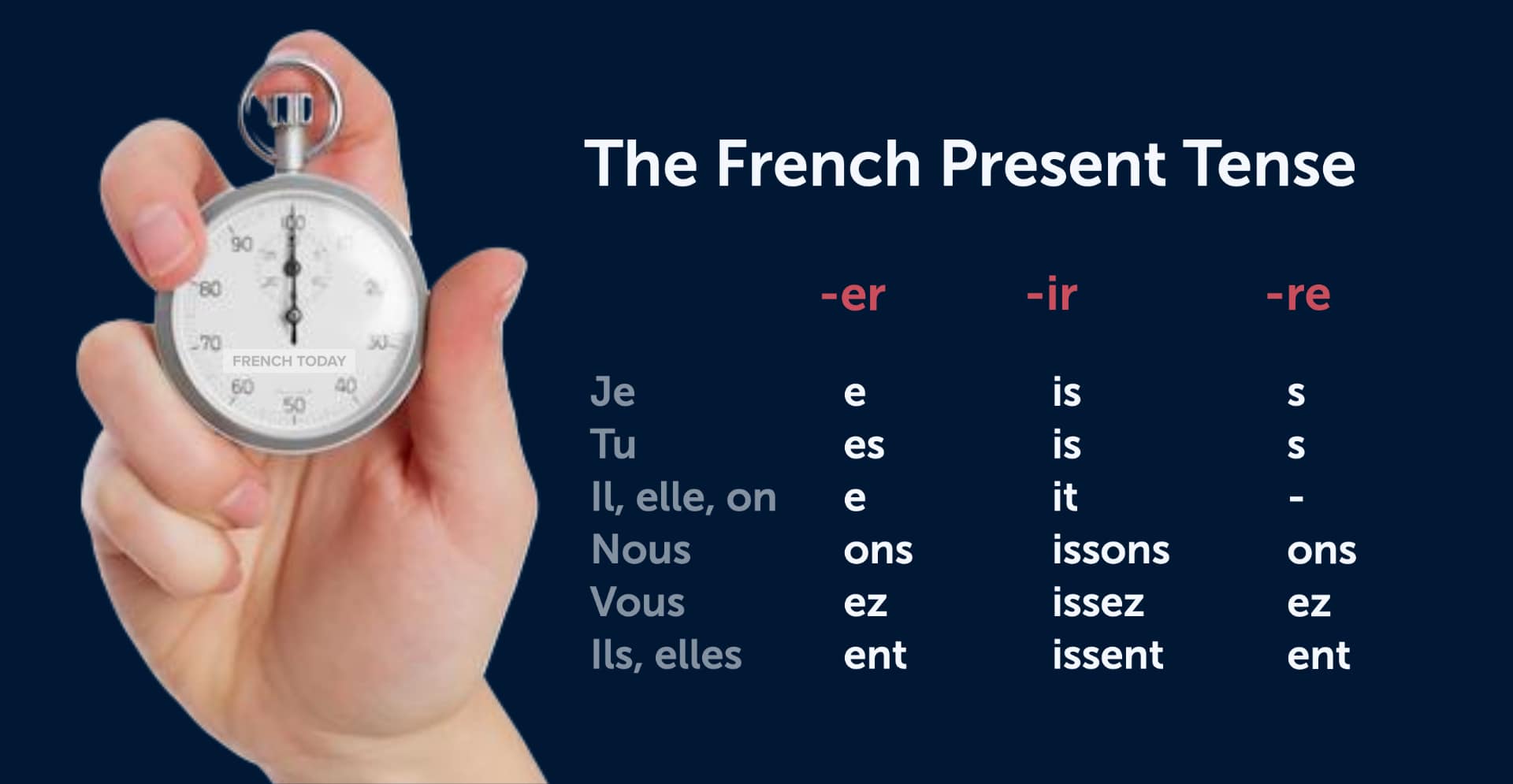
For example, for “parler”, here is the logic explained by traditional methods:
- Remove the “er” – this will give you what is called “the stem” in grammatical jargon.
Parler – er = parl - To the stem, add the ending corresponding the the subject pronoun
Je = stem + e = je parle
Tu = stem + es = tu parles
Il, elle, on = stem + e = il, elle, on parle
Nous = stem + ons = nous parlons
Vous = stem + ez = vous parlez
Ils, elles + stem + ent = ils, elles parlent
This is simple enough, and students spend hours upon hours writing these verb conjugations down.
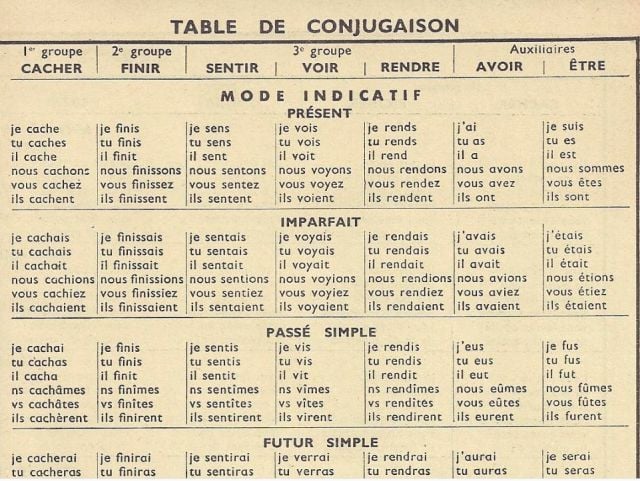
Grammar books have pages upon pages of French conjugation tables, for the French present indicative tense but also all the other French tenses and French moods, and they promise that when you practice this way, you’ll master your French verb conjugations.
I beg to differ!
The problem is that nobody teaches how to learn the French verb properly.
So first, let’s consider your brilliant brain, shall we?
Consider Your Brilliant Brain
So let’s start at the beginning, with the French subject pronouns.
Most of the time, when you’re conjugating a verb, you’ll use a subject pronoun.
Always Conjugate A Verb With A Subject Pronoun
It’s essential that you learn the subject pronoun WITH its verb form. In other words, if you go: “parle, parle, parle, parlons, parlez, parlent” it does nothing for your brain: you repeat sequence of words that have no meaning.
Furthermore, you’d be messing up the pronunciation, since there are often important liaisons or elisions between the pronouns and the verb. Check-out my free “être” audio lesson and see how the pronunciation differs with the liaisons and glidings that happen in modern spoken French.
So the very first step is to think about what you are saying! Picture someone doing something. Your brain will process and store the verb forms much longer if you add a meaning to it.
Make Sure Your Drill French Verb Conjugations With All The Subject Pronouns
There are 9 French subject pronouns. Je, tu, il, elle, on, nous, vous, ils, elles.
Most French conjugation tables show only 6: je, tu, il, nous, vous, ils. Not only is it sexist, but it’s terrible for French students, who then don’t practice enough conjugating with the feminine form – and usually know almost nothing about the French subject pronoun on.
So please, don’t make this mistake. Drill with ALL the 9 subject pronouns.
Conjugate The Verbs Out Of Order
Did you notice you never remember the “ils” (plural) form? It’s because you’ve only conjugated the French verbs in order, from “je” to “ils”. And your super smart brain then thought there was a reason for it. It meant that “je” was important (and you usually “picture” the situation much more with “je” anyway) and “ils”… not so much. So it prioritised the info.

Now, let’s talk about something that really bothers me…
The French Verb Classification Absurdity
The French verbs are classified among three groups of verbs whose conjugation pattern is “predictable”.
- The first group = French verbs ending in “ER“
- The second group = French verbs ending in “IR”
- The third group = French verbs ending in “RE”
So far, it looks logical…
EXCEPT that in French, we also have a ton of “irregular” verbs. Verbs whose conjugation pattern is either not at all predictable, or even sub-categories, several verbs which follow the same irregularity and therefore form a sub-group.
The first group, the “ER” group only has one irregular verb: a verb that ends in “er” BUT that doesn’t follow the same conjugation pattern as “parler”. It’s a big one too, the verb “aller” which is SO very useful in French… Well, already it’s not exact, since there are also the verbs that end in “ER”, are regular for their endings, but will change stem spelling… Such as “jeter”. But I digress…
So, the first French verb group ending in “ER” is relatively solid. Many useful verbs are indeed conjugated according to this pattern.
However, in my humble opinion, the two other “groups” have so many exceptions that they almost make no sense…
Yes, OK, verbs like “grossir” (to gain weight), “finir” (to end), “choisir” (to choose)… are regular “IR” verbs.
But many, many verbs ending in “IR” are irregular.
And they are very, very common verbs: “venir” (to come), “tenir” (to hold), “sortir” (to exit), “dormir” (to sleep), “partir” (to leave) or even “dire”(to say – yes I know, it’s spelled IRE but it sounds like IR) and the list goes on and on…
So, how does a student know which “IR” verb is regular or not?
When there are so many exceptions to a group, and the exceptions are the most useful/ commonly used verbs, should you still emphasize the group so much?
Should students spend hours drilling on these “IR” and “RE” groups, or rather spend that time drilling on the most common irregular verbs which they are certain they’re going to be using on an everyday basis?
This is precisely the logic I applied in my unique audiobooks French Verb Conjugation Drills.

Train your verb memory with short 6-minute drills in 25 different forms and tenses
The Secret To French Verb Conjugation
How do you think French children remember all these French verb conjugations?
If it were that difficult, they wouldn’t be able to talk at all!
The secret, the one thing French method should actually focus on, is the correct French pronunciation of these verbs.
Take the verb “parler” in the present tense.
- “Je, tu, il, elle, on, ils, elles” verb forms are all pronounced exactly the same = “parl”. Just like the stem.
- The “nous from” is pronounced “on” (nasal) = “parlon”
- The “vous” form is pronounced “é”, just like the infinitive form of the verb “parler”. So “parlez = parler = parlé” in pronunciation.
French is a living language. People use it every day to communicate. I’m not saying it’s an easy language, but it’s easier than the traditional way of teaching it!

The same exact logic could apply to the French passé composé agreements:
- Parler, parlez, parlé, parlée, parlés, parlées = “parlé”
They are all pronounced the same way.
When you’re speaking French and the verb ends in a [é] sound, you shouldn’t even think about the way it’s spelled. It’s only in writing that it matters!
You should first learn to speak French. Pronounce it properly. Then (and only if you need to) focus on writing the verb form in French! That’s exactly how French kids do it.
A Terrible – However Common – French Verb Mistake
If more focus was placed on the French verb pronunciation, I wouldn’t hear so many students pronounce the silent “ent” of the “ils/elles” forms of French verbs.
However, it’s one of the most common mistakes I hear! You have no idea the number of advanced French students that butcher their French verbs!
And don’t even get me started on the liaisons and silent letters. Did you know that the S of “nous” and “vous” is NEVER pronounced like an S? Never ever, ever!
It’s either silent, or it’s pronounced like a Z in liaison.
In other words, it would be much simpler if you’d learned:
- Nous = noo
- Vous = voo
And then learned the French verbs requiring elision in French and liaison with their correct pronunciation right away.
Big Mistake = Learning Your French Verb Conjugations Without Audio
So, you could say that audio is kind of a new thing, that up to now, most books didn’t have audio and that’s why they were written this way.
In my opinion, nowadays, it’s a crime to develop a French learning method without audio.
However, look at this present article. Unlike all my downloadable French audiobooks, this article doesn’t have audio, does it? Yet, I could make my point across.
It’s a question of thinking outside the box.
Now check my free audio guide featuring the French verb être conjugations and pronunciation. I bet that’s not how you learned to pronounce that verb…
This being said, each French student should have a Bescherelles or other French verb book to check the way a French verb is spelled.
It’s a good investment because if you intend to write French, you’ll need such a book: we all do (it’s a requirement for every French school kid who eventually has to learn how to spell the verbs)!
The Key To Learning French Successfully = Prioritize
I’m not saying that all the other French learning methods are wrong. Their content is correct, or course. It’s the approach that is wrong.
A five-years-old has been conjugating “parler” and saying “tu parles” correctly for half of his life… Then when s/he learns to write, s/he will discover with surprise that the French you, the “tu” form is usually written with a silent “s”. It’s all news to him/her as well, and a big shock! And teachers will correct that mistake for years on, believe me.
So, of course, our adult mind doesn’t work like the one of a toddler. And knowing grammar can and will actually help you master French: I strongly believe understanding French verb grammar is actually essential to mastering French. And it will allow you to save time.
However, if you are learning French to communicate in French, and not only to pass written exams, you really need to learn everything with audio, and examine the logic of the French learning method you are using.

A new approach to learning both traditional and modern French logically structured for English speakers.
6 Steps To Master French Verb Conjugations
Here is my solution in six steps to master French verb conjugations and gain speed when speaking French:
1 – Learn how to pronounce the verbs correctly
If you’re learning French to speak French, then focus on the pronunciation.
2 – Practice out-loud
Practice out-loud and with audio with the most useful verbs (no matter whether they are regular or not).
3 – Say the verb with its pronoun
Always drill out-loud with the verb and the pronoun at the same time.
The pronoun and the verb should come naturally together with the correct elision, liaison or gliding.
Drilling in your head won’t work, either: you need to hear it as you say it.
4 – Drill at random
That’s another stupid thing traditional methods do: they always have you drill from “je” to “ils”.
Your super efficient brain therefore prioritizes the verb conjugation this way, and then you are surprised when you can never remember the “ils” forms…
5 – Prioritize
A beginner has no need to learn the French subjunctive. It should not be its priority yet.
Make sure you know the present indicative inside out. It’s the tense we use in most conversations. It’s also the tense on which most of the other tenses are based (for example, the base for the French imparfait is the “nous” form of the present indicative)
6 – Drill in the affirmative and the negative
Students usually only drill the French verbs in the affirmative.
Drilling in the negative is essential so you don’t have to “build” your negative form and waste time.
Same for the inversion used in question.
Do The French Know Which Verb Tense To Use?
If you believe all French people understand French conjugation, and know when – or how – to use the subjunctive, for example, you are mistaken.
Yes, we did learn it in school. But it was a long time ago. And we were not necessarily paying attention (although French grammar and conjugation a huge part of the French school program – a much bigger part compared to English grammar in an English-speaking countries)
Instead, we rely on our French ear. It’s because we know how to speak the language that we can write it correctly.
For example, if I’m writing :
- Il faut que tu aies du courage = You need to be courageous.
I’m going to be very tempted to write “il faut que tu es du courage”. Why? Because “tu es” is widely used, and it sounds the same way as “tu aies”. Ok, it’s not the same mood (indicative ≠ subjunctive). It’s not even the same verb! (être versus avoir) but it’s such a strong habit to write “tu es” that it’s actually a very common mistake.
So how would I know that it’s subjunctive? I’d switch the verb for an irregular French subjunctive :
- Il faut que tu saches… for example.
Even if the rest of the sentence doesn’t work with “savoir”, since it’s the “il faut que” that triggers the subjunctive, it’s enough. A French person should know the rule. But more often than not, we’ll rely on tricks to find out the right tense.
Of course, this doesn’t work for foreigners since it’s unlikely that you can rely on your French ear… But actually, you may, if you’ve learned your French language with audio, in context, with my audiobooks for example ;-)
If what I’ve explained in this article rings a bell, then I encourage you to sample my audiobooks to learn French: click the links below to hear an audio sample, read the description and access a table of content.
- The A Moi Paris series is a complete French learning method illustrated by a lively novel, to master both traditional and spoken modern French, organized by levels and starting at a true beginner level. This series explains it all: vocabulary, sentence structure, and of course also the French tenses, how to build them and when to use them.
- The French verb drills are a revolutionary method to memorize the French verb forms, master their correct pronunciation and gain speed and confidence when speaking French.
Good luck with your French studies, and remember, repetition is the key!




Comments