

Hi! We’re Bill and Cindy, French immersion students at Emilie’s. One day, she offered we go bake bread, and then write an article on this unique experience for French Today. Here it is! Before you start, I invite you to study Emilie’s article about the French baking terms.
Use the floating blue icon in the bottom right to hide/reveal the English translations below or just click here.
Lundi dernier, nous nous étions baladés avec Emilie, et sa fille Myrtille, pour aller acheter du pain au château de Boussan, en Occitanie.
Last Monday, we had taken a walk in the countryside with Emilie and her daughter Myrtille to buy bread at Boussan castle, in the Occitane region of France.
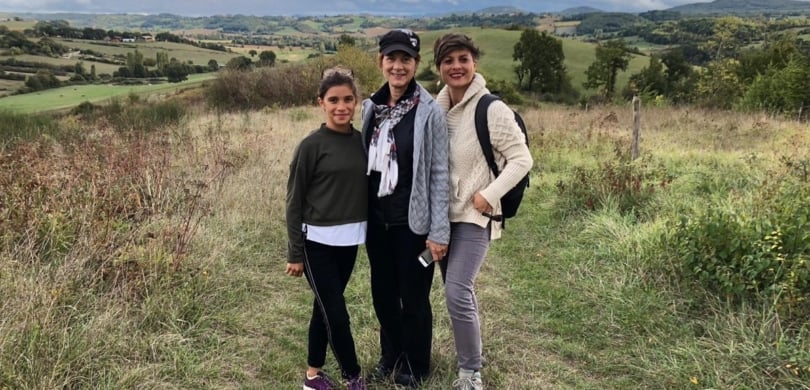
Nous y avions rencontré la famille Mauvais – de leur vrai nom –. Ce sont des fermiers qui habitent dans un château et qui ont une exploitation agricole depuis 25 ans.
There we met the Mauvais family – their real names [mauvais means bad]. They are farmers who live in a big country house (called castle) and who have been farming their land for 25 years.
To study the French bread vocabulary, I invite you to follow the link to Camille’s article.
1 – Baking Bread is For Early Risers!
Nous sommes lundi. Le réveil sonne à 5h45. Quelle idée de tomber du lit si tôt, nous sommes à la retraite, quand même! Nous nous levons de bonne heure, de bonne humeur, car aujourd’hui nous allons jouer les apprentis boulangers dans les petites Pyrénées.
It’s Monday. The alarm clock goes off at 5:45 a.m. What an idea to drag ourselves out of bed so early, we’re retired after all! Nevertheless, we arise early and in a good frame of mind because today we are going to play apprentice bakers in the “petites Pyrenées.”
2 – Meeting French Bread Bakers
La famille Mauvais – Jean-Paul, Françoise, et leur fils, Henri – en plus d’élever des vaches et de faire pousser des légumes, font aussi leur propre farine avec leur blé, et font du pain une fois par semaine, le lundi. En les rencontrant, Cindy a eu envie d’apprendre à faire du pain. Ça tombait bien, Emilie voulait justement nous proposer cette activité pour notre immersion dans la culture française. Cela explique pourquoi nous sommes si matinaux aujourd’hui. C’est parti, “nous avons du pain sur la planche” !
The Mauvais family – Jean-Paul, Françoise, and their son Henri – besides raising cattle and growing vegetables, make their own flour from the wheat they grow, and make bread once a week, on Mondays. Upon meeting them, Cindy wanted to learn how they made their bread. The timing couldn’t have been better as Emilie wanted to suggest this activity as part of our immersion into French culture. This explains why we got up so early today. Let’s go! We have a lot to accomplish!

3 – How To Bake Bread
En fait, le procéssus commence le samedi soir : Françoise nourrit le levain à partir d’un morceau de pâte restant du précédent lundi qu’elle rallonge avec de l’eau.
In truth, the bread-making process begins on Saturday evening when Françoise prepares the yeast by adding water to the bit of dough she has saved from the previous Monday.
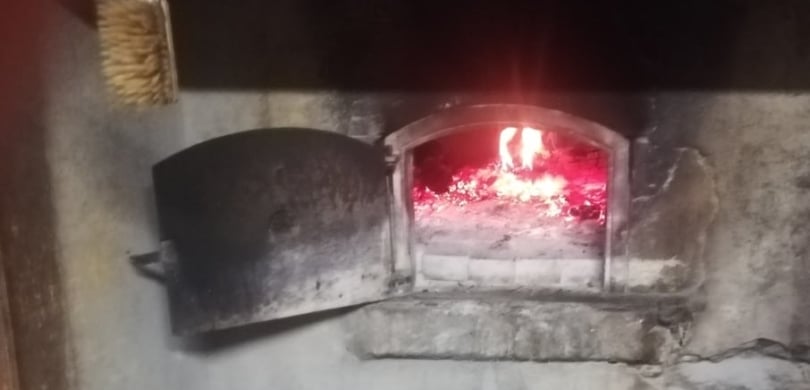
Le lundi matin, à six heures dans la dépendance non loin du château, Henri allume le four à pain en posant du bois sur les briques. De 6h à midi, le bois va se consumer.
At six a.m. on Monday morning,in a small building not far from the chateau, Henri “turns on” the bread oven by setting wood on top of the oven bricks. From 6AM to noon, the wood will be totally consumed (leaving nothing but ashes.)
4 – Preparing the Bread Dough
Jean-Paul pèse la farine et prépare sept bassines de farine blanche, une bassine de farine au sésame, une bassine de farine aux raisins, et une bassine de farine complète.
Jean-Paul weighs the flour and prepares seven large bowls of white flour, one bowl of sesame flour, one bowl for raisin bread, and one bowl of whole wheat flour.
Françoise ajoute du gros sel de Guérande, le levain, et l’eau.
Françoise adds salt from the Guérande region of France, the prepared yeast, and the water.

Ensuite, tout le monde “met la main à la pâte” et pétrit la pâte. L’expression “mettre la main à la pâte” signifie aussi au sens figuré “se mettre au travail ou participer à une tâche”.
Then everyone sets to work and kneads the dough. The French expression, literally “put the hand in the dough” means figuratively speaking “set to work or participate in an endeavor/task”.
Jean-Paul nous conseille de pétrir avec une main pour garder une main libre. A ce stade, la pâte est vraiment très collante, et nous comprenons tout le sens de l’expression imagée “être dans le pétrin”, à savoir être dans une situation dont il est difficile de sortir.
Jean-Paul advises us to knead the dough with one hand so as to keep one hand free. At this stage, the dough is really sticky and now we understand better that “to be in the dough” means to be in a ‘sticky’ situation that is hard to get out of.

Pendant que la pâte lève, les Mauvais nous invitent à petit-déjeuner au château. Ils nous servent de la brioche spécialement préparée pour nous la veille avec de la confiture, le tout fait maison bien sûr.
While the dough is rising, the Mauvais invite us to have a French breakfast at the chateau. They serve us brioche bread that was prepared specially for us the day before, and jam, homemade of course!
5 – Cutting the Bread Dough
Après le petit dej’, nous retournons à la dépendance. La pâte a bien levé. Jean-Paul prend chaque bassine, tour à tour, et verse la pâte sur la table principale. La pâte est coupée en portions et pesée précisément.
After breakfast, we return to the outbuilding, where the dough has well risen. Jean-Paul takes each bowl and, one by one, turns it upside down on the main table. The dough is cut into pieces and precisely weighted.

La troupe façonne les portions tantôt en forme de baguettes, tantôt en petites boules ou encore en pains moulés ou non moulés. Françoise n’oublie pas de mettre un peu de pâte de côté pour préparer le prochain levain.
The team forms the portions of dough sometimes into baguette shape, sometimes into small or large round loaves, or loaves to be cooked in a bread pan. Françoise does not forget to set aside a portion of the dough to be used as yeast for next week’s loaves.
Juste avant midi, Henri enlève les cendres du four et nous retournons tous au château manger le repas de midi.
Just before noon, Henri removes the ashes from the oven, and we return to the chateau to eat the lunch.
La Famille Mauvais nous offre un déjeuner vraiment délicieux. Le repas ne comprend que des produits de la ferme : pâté de sanglier, girolles au vinaigre, salade de tomates et haricots verts du jardin et enfin, un poulet fermier.
The Mauvais family treats us to a really delicious lunch. The meal only includes dishes made from their farm products: wild boar pâté, pickled chanterelle mushrooms, fresh tomato and garden green beans salad, and roasted farm-raised chicken.

6 – Baking the Bread in the Oven
Après le déjeuner, c’est l’heure de cuire la pâte. Les briques du four à pain qui ont emmagasiné la chaleur toute la matinée vont maintenant la restituer tout l’après midi pour cuire les pains.
After lunch, its time to bake the dough. The oven bricks, which have been storing up heat all morning, will now stay hot enough to bake bread all afternoon.
Les pains façonnés le matin sont introduits dans le four en commençant par les fougasses, un pain typique de la région en forme d’épi de blé.
The loaves formed in the morning are put in the oven, starting with the fougasse loaves, a bread typical of this region and shaped to resemble an ear of wheat.
Puis, c’est au tour des baguettes, des petites boules et des plus grands pains.
Then, the baguettes, the small round loaves, and the big round loaves get their turn.
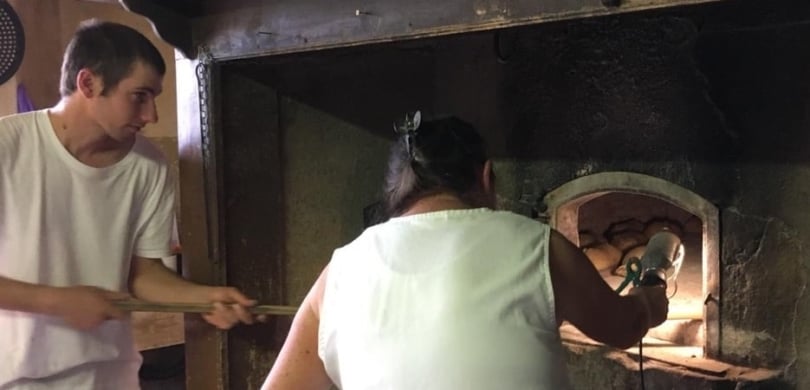
Nous assistons a une véritable chorégraphie, faite de gestes et de déplacements qui se répètent. Henri ouvre la porte du four, Françoise éclaire le four, Henri, à l’aide de la grand pelle, sort le pain qui est cuit et enfourne la fournée suivante. Puis, Jean-Paul démoule les pains et les laisse refroidir.
We witness a true choreography of movements and actions that are repeated over and over. Henri opens the oven door; Françoise lights up the oven with a lamp; Henri, with the help of a big paddle, takes out the loaves that are baked and puts the next batch in. Then Jean-Paul unmolds the loaves and leaves them to cool.
Et enfin, les assistant (e)s brossent les pains pour enlever les dépôts de cendres.
Lastly, the assistants brush each loaf to scrape off any ashes.

7 – Selling the Bread
En attendant la cuisson des derniers pains, tandis que nous entendons les premiers clients arriver au château, Françoise prépare les commandes dans des sacs en papier. Le reste du pain est transporté dans de grands paniers. Tout le monde se dépêche pour ne pas faire attendre davantage les clients. Il reste des petites choses à faire. Nous entendons plusieurs fois“ je ne peux pas être au four et au moulin”. C’est Henri qui ne peut qu’être à un seul endroit à la fois, autrement dit, il ne peut faire qu’une chose à la fois.
While waiting for the last loaves to bake and expecting the first clients to be arriving at the chateau, Françoise bags up the pre-orders. The remaining loaves are taken to the chateau in big baskets. Everybody is hurrying so as to not keep the clients waiting too long. There are a few things left to do. We hear a number of times the expression “I can’t be at the oven and at the mill.” This is Henri, who cannot be in two places at once, otherwise put, he can only do one thing at a time.
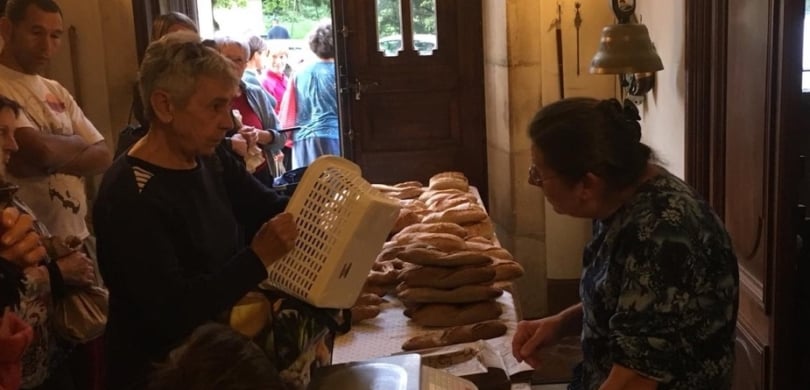
Les pains sont tout chauds et sentent délicieusement bons. Il est 18h. Les différents pains sont alignés sur la table dans le hall d’entrée du château, où il sont vendus en un temps records. On comprend alors l’expression “partir comme des petits pains”!
The bread is still warm and smells delicious. It is 6 p.m. The different loaves are lined up on the table in the entrance hall of the chateau, where they are sold in record time. Now we understand the expression “partir comme des petits pains” that is to say “to sell very quickly.”
8 – Conclusion
C’était une expérience unique. La journée a été longue mais ça valait vraiment la peine! Bravo à la famille Mauvais – et, bien sûr, à Emilie de nous avoir permis de vivre cette journée mémorable.
This was truly a unique experience. It was a long day, but well worth it! Congratulations to the Mauvais family and – of course – to Emily, for making it possible for us to have this memorable experience.






Comments