
So many things can be soft : soft as the fur of a kitten, soft as the sound of a voice, soft as a mattress. What about soft in French? What’s the difference between “doux, mou and moelleux”?
Let’s see the different ways to translate soft in French.
Doux = Soft, Mild, Gentle
- Masculine: doux (x silent, so it sounds like “doo”)
- Feminine: douce(s)
- Noun : la douceur
- Verb: adoucir – to soften
- Adverb: doucement – softly, gently
We use “doux” a lot in French as soft for fabric, skin, texture in general:
- Ton pull est tellement doux
Your sweater is so soft. - Le bébé a la peau douce
The baby has a soft skin. - Cette surface est rugueuse. Je préfère celle-ci: elle est plus douce, plus lisse.
This surface is rough. I prefer that one: it’s softer, smoother.
In French “doux” is soft for taste: mild. Not too strong, not too spicy.
- Ce curry est doux
This curry is mild.
We also use “doux” for a person. In this case, it means gentle.
- Ce garçon est très doux avec son petit frère
This boy is so gentle with his little brother. - J’adore la douceur de son regard –
I love the gentleness of his eyes.
Mou = Soft, Flabby
- Masculine: mou
- Feminine: molle
- Noun: la mollesse (but we don’t use it often)
- Verb: ramollir – to soften
- Adverb – mollement – flabbily
Note that “mou/molle” have what I call a mutant form: “mol” which is followed by a masculine word starting with a vowel or a mute H. Such as “un mol adolescent” (a flabby teen). French adjectives, their tricky pronunciation and agreement rules are explained in depth in French Today’s audiobook “Mastering French Adjectives”.

All the logic that rules French adjectives as well as a lot of truly useful vocabulary
We use “mou” as soft for a texture that gives in when you press on it: a bit like mushy, or flabby.
- À cause de ses problèmes de dents, il ne peut manger que des choses molles, comme de la purée.
Because of his teeth problems, he can only eat soft things, such as puree.
“Mou” often has a negative feeling to it.
- Je n’aime pas les matelas mous. Je préfère les matelas fermes.
I don’t like soft mattresses, I prefer firm ones.
For people, “mou” is quite negative. It means unenergetic, often even lazy.
- Patricia n’a aucune ambition. Elle ne sait pas saisir les opportunités. Je la trouve molle et sans intérêt.
Patricia has no ambition. She doesn’t know how to seize the opportunities. I find her flabby and not interesting.
Moelleux = Soft, Spongy
- Masculine: moelleux (x silent)
- Feminine: moelleuse
- Noun: la moelle (watch out, this is marrow… as in bone marrow)
- No verb that I know of.
- Adverb – moelleusement exists, but I’ve never used it myself.
“Moelleux” is never used for a person. It’s only used around texture, mostly for food, wine and bed items.
“Moelleux” is not far from “mou”, except that it carries a positive feeling to it.
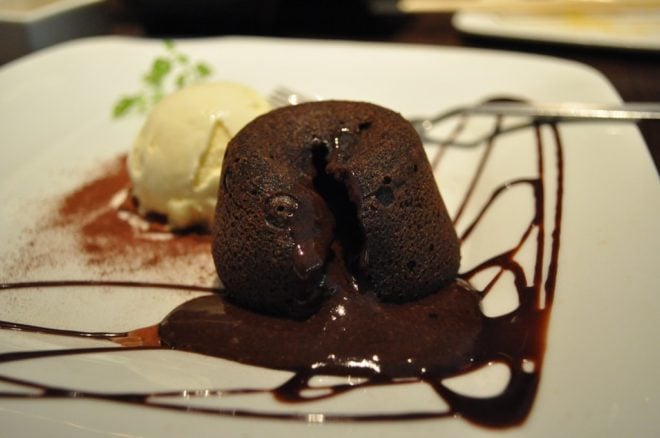
In French, we use “moelleux” for runny, or spongy pastries.
- J’adore le moelleux au chocolat
I love chocolate fondant (see main picture of the article: credit emi Morya of Flickr) - Je préfère les biscuits moelleux : je n’aime pas les biscuits secs.
I prefer soft cookies: I don’t like dry cookies.
“Moelleux” is used around French wines. For white wines, a wine which is lightly sweet. For red wines, a bit oily and stretchy.
- Le Sauterne est un vin moelleux, généralement pas aussi sucré que le Muscat.
Sauterne is a mildly sweet wine, usually not as sweet as the Muscat.
We also use it for pillows, beds, sofas or blankets: something you’d like to nest into: soft and cozy.
- J’ai dormi comme un bébé. Les oreillers de cet hotels sont bien moelleux.
I slept like a baby. The pillows in this hotel are really comfy.
Learn French in context, check out French Today’s downloadable French audiobooks: French Today’s bilingual novels are recorded at different speeds and enunciation, and focus on today’s modern glided pronunciation.
You’ll find exclusive mini lessons, tips, pictures and more daily on French Today’s Facebook, Twitter and Pinterest pages – so join me there!


Comments