French Poem Readings
In this section, I am going to read classical French poems twice: once slowly - so you can repeat after me - and once faster, with my own interpretation of the poem. I will also sometimes tell you about the author, or explain the vocabulary or the meaning of the poem, all in easy everyday French.
In my "Easy French poems and analysis" series, I read, paraphrase, analyse the very most famous French poems, such as "Demain, dès l'aube", "la Cigale et la Fourmi", "Parfum Exotique"... and talk about the author's life (Hugo, La Fontaine, Baudelaire...). These analysis are a great way to improve your understanding and vocabulary, and learn about French culture and poetry.
I will be adding new readings regularly, so come back often, or subscribe to my newsletter to receive exclusive French tips, sales and updates.
"Délie XXIV" de Maurice de Scève
Published in 1544, Scève's "Délie, objet de plus haute vertu" is a cycle of 449 poems, an endless examination of the physical and spiritual pains of an impossible love.
"Le Chêne et le Roseau" de Jean de la Fontaine
This fable tells a great story about a reed (which represent the people) and an all-mighty oak (representing the king). The oak thinks he is indestructible, and says the reed is very unfortunate to be what he is. The oak wishes he could help the reed, but he knows he cannot and pities him. The reed however, says he might not be strong, but he is tough. And that is the true strength. To prove him right, a huge storm arrives and takes the oak down.
This was very courageous of La Fontaine to present this fable to the king, since the message is that the king is not as powerful as he thinks he is...
"Le temps a laissé son manteau" de Charles d'Orléans
Today's poem is very simple and is studied by French middle school students as an introduction to Old French. I am going to read the poem, but also explain the text in French and speak about the author.
It's about the arrival of spring. The descriptions are charming and talk to all our senses: we can feel the coat of Winter against our skin, our ears capture the animal songs celebrating the upcoming Spring, and our eyes are blinded by the reflection of the sun over the rivers full of winter's waters.
Read more: "Le temps a laissé son manteau" de Charles d'Orléans
"La Cigale et la Fourmi" de Jean de La Fontaine
Like most of La Fontaine's fables, "La Cigale et la Fourmi” is not a story that he invented. Drawing inspiration from oral traditions and the fables of Aesop and other poets of Greek and Roman antiquity La Fontaine changes the classic fable by omitting the moral. Why? Listen to the poem's analysis to find out.
"La Laitière et le Pot au Lait" de Jean de la Fontaine
Didn’t your Mom always tell you “watch where you walk”?
This charming and well known fable is the perfect example of why you should.
Read more: "La Laitière et le Pot au Lait" de Jean de la Fontaine
"Préface" de Paul Claudel
Je suis rentrée en France, apres 18 ans de vie aux Etats-Unis et donc ce poème a pour moi une signification tout à fait particulière. Vous entendrez dans ce poème que je suis très émue...
"Parfum Exotique" de Charles Baudelaire
I chose this poem quite simply because it is one of my favorites. Of course, like many French and Americans, I adore Baudelaire for his stylistic originality and his extreme sensitivity. I love this poem because it is simply beautiful, highly sensual, and surprisingly positive for a Baudelaire poem!
"La Chevelure" de Charles Baudelaire
This is an extremely sensual poem typical of Baudelaire's style.
"Chant d'Automne" de Paul Verlaine
This sad and melancholic, yet wonderful, short poem is also charged with historic meaning. You might be familiar with the first 2 verses which were used by General de Gaulle, chief of the resistance and future president of the liberated France, in the days and hours preceding the launch of D-day.
"La Maison Du Berger" d'Alfred de Vigny
This 19th century poem, 336 verse long, is in fact very philosophical and talks about the human condition. Written in Alexandrines, the poet entices a woman (Èva) to leave urban life, and live in Nature (considered as God's creation) which fascinates him as much as it disgusts him."La Maison du Berger" (the Sheppard's House) is in fact a mobile home: it is therefore a symbol of mobility which allows the poet to live in the middle of Nature, and then come back to the city.
"Le Niagara" de Louis Fréchette
I'm going to talk about one of the most well known Canadian poems, and share with you a narrative of the poet's life, and analysis of the poem as written by a dear student of mine.
"Ode à Cassandre" de Pierre de Ronsard
This poem – written in the 16th century for King Charles IX's court – is a very well done exercise of style.Based on a quite common image – a girl and a rose – Ronsard manages to create a graceful and sensual poem that glorifies the game of seduction.
"Ballade des Dames du Temps Jadis" et "Épitaphe" de François Villon
Today, I’m going to read 2 poems of the 15th century: I will read them once in current French, and once in 15th century French, in their original form, and I will also present you the life of Villon.
And you'll also get a bonus; the interpretation by French songwriter George Brassens of "Ballade des dames du temps jadis".
Read more: "Ballade des Dames du Temps Jadis" et "Épitaphe" de François Villon
"Je vis, je meurs" de Louise Labé
The first recognized French poetess, Louise Labbé was born in Lyon, between 1520 and 1525. She was raised during one of the most interesting centuries in literature's history. The Middle Ages were over, and the Italian renaissance was creating a revolution in France’s artistic life. The message is simple and still so very modern: love and its torments...
"Les Vous et les Tu" de Voltaire
"Les Vous et Les Tu" is a sensual, yet very deep poem from Voltaire, 18th century.
Particularly interesting for students is that it plays on the difference between Tu and Vous, since Voltaire says "tu" to the woman he loved, and "vous" to the one she became.
"Apparition" et "L'Après-midi d'un Faune" de Stéphane Mallarmé
This time, I'm going to read 2 poems by Mallarmé. The beginning of L'Après-midi d'un Faune is one of my favorite poems to read out loud. It’s pure music, with flashes of enchanting images.
I am not quite sure what the story says, but the rhythm of the melody is enough to delight me.
Read more: "Apparition" et "L'Après-midi d'un Faune" de Stéphane Mallarmé
"Les Pas" de Paul Valéry
In this classical yet sensual and very musical poem, Valéry describes two people: the “I” who represents the poet (who is in his bed and not sleeping) and a feminine entity who is approaching.
Ghost? Fairy? Or would it be the poet's muse?
"La Feuille Blanche" de Paul Valéry
“La Feuille Blanche” is one of the most famous poems by Paul Valéry. It talks about what a writer feels in front of a white page, and the consequences of his actions.
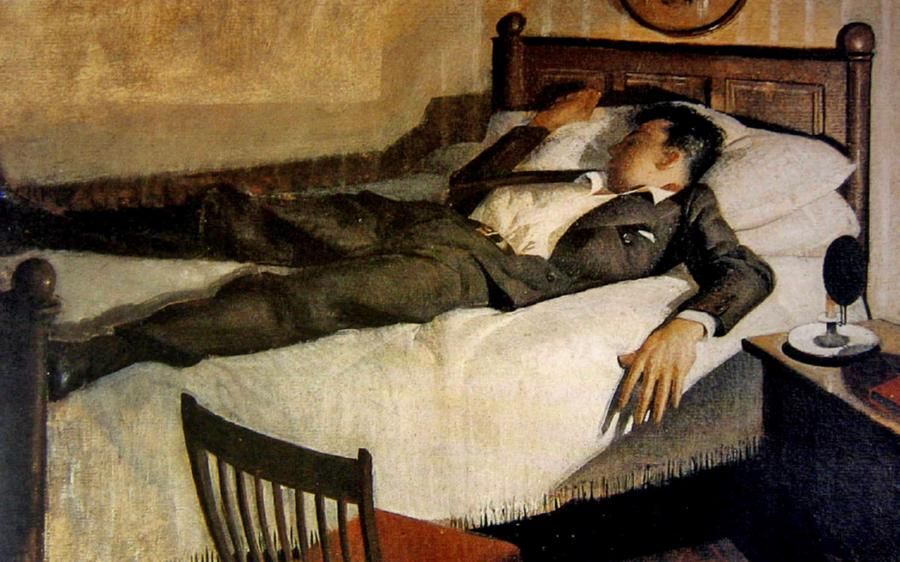
"Le Dormeur du Val" d'Arthur Rimbaud
This poem, written by the 16-year old Rimbaud, is partially in the classic form but already announces his future avant-garde poems. When he wrote this piece, France was at war with Prussia, and Rimbaud was frequently running away from home and traveling by foot. It is therefore possible that the scene described in the poem is a real scene.
"Tristesse" d'Alfred de Musset
Alfred de Musset is a poet of the beginning of the 19th century in Paris. Mostly known for his romantic poems, his theater pieces and his novels, de Musset's first collection of poems won the approval of Victor Hugo, who accepted him in his Romantic literary circle: Cénacle.
He was the lover of the women writer George Sand, who was the inspiration for this poem.
"Le Pont Mirabeau" de Guillaume Apollinaire
Legend has it that this poem was inspired by the rupture between Apollinaire and the female painter Marie Laurencin, because he had to cross the Mirabeau bridge to go see her. In an ultra modern form, with short verses, a refrain that repeats throughout the poem like a song, and without punctuation, the poem speaks of the classic themes of the fatality of passing time and the pain of love.
"Le Lac" d'Alphonse de Lamartine
Lamartine, a pioneer of the French Romantic movement, is considered one of the greatest French poets of the nineteenth century. In this poem Lamartine talks about the ephemeral nature of life and love.
Written in highly melodious and emotional verse, "Le lac" epitomizes the lyrical qualities of Lamartine's poetry.
"Elle était déchaussée, elle était décoiffée" de Victor Hugo
This little known Victor Hugo's poem is very charming, short and easy to understand. It's about a boy who is taking a walk by a stream and suddenly discovers a beautiful, wild, and irresistible young woman bathing her feet...
The poem has real cinematographic quality to it; you can picture the scene as if you were there.
Read more: "Elle était déchaussée, elle était décoiffée" de Victor Hugo
"Heureux Qui Comme Ulysse" de Joachim du Bellay
Created in the 16th century, this classic French poem is written in Middle French; it is not modern, but easily understandable. Once the construction and vocabulary has been explained, it is an easy poem, even for a French beginner.
"Carmen" de Théophile Gautier
In May 1840, Théophile Gautier, the enfant terrible of the French Romantic movement, was hired by the journal “La Presse” to record his experiences and impressions of Spain. The end result was the book “Voyage en Espagne” (1845), an enthralling piece of travel writing later translated into English as “A Romantic in Spain”.
For Gautier, Spain was an exotic and passionate culture. "It was a revelation", he said later, like discovering his true home, the native land of his spirit.
"Demain dès l'aube" de Victor Hugo
Far from being one the best-known masterpieces of Victor Hugo, this beautiful poem takes us for walk through Normandy’s countryside. The destination of the journey is a mystery. One first imagines a lover’s date... but the poem will unravel a meaning much deeper to the poet’s heart.
"Poème Sur Une Morte" d'Alfred de Musset
This poem was written for the extraordinary princess Christina di Belgiojoso, who was a striking, dark-eyed and dark-haired, pale-skinned beauty Musset met at one of the Paris salon.
Musset threw his heart at her feet, but was received as a friend, and rejected as a lover. In anger, he wrote this poem.
"El Desdichado" de Gerard de Nerval
Today, I'm going to present you a rather complicated poem, which speaks of French historic characters and refers to legends from France and the Roman and Greek antiquity. Rather dark, yet full of hope, this poem is gorgeous and profound, and one can find a new meaning with each reading."Le Corbeau et le Renard" de Jean de La Fontaine - FREE Sample for Easy French Poetry Readings And Analysis
Aujourd’hui, je vais vous parler du poème “Le Corbeau et Le renard” de Jean de La Fontaine. Je vais parler lentement, clairement et utiliser un vocabulaire de tous les jours pour expliquer, et puis discuter du poème.
Tout d’abord, je vais lire le poème lentement. Puis je vais expliquer le vocabulaire, et puis je vais vous parler du message du poème, et de la vie de l’auteur. Enfin, je vais relire le poème plus rapidement.